
Key Trends in Parking Management Software
Key Takeaways
- Adoption of AI and predictive analytics enhances parking efficiency.
- Integration with IoT devices provides real-time data for better decision-making.
- Cloud-based platforms offer scalability and remote management capabilities.
- Automated enforcement systems improve compliance and security.
- Sustainable solutions support environmental goals and innovative city initiatives.
The landscape of parking management is rapidly evolving as cities seek more innovative and sustainable mobility solutions. From advanced AI algorithms to cloud-based oversight, technology is revolutionizing the parking experience for both operators and drivers. Thanks to innovations like parking software for real-time occupancy and payment tracking, urban planners and businesses can streamline operations, enhance customer satisfaction, and achieve new levels of efficiency.
The adoption of digital tools not only meets rising expectations for convenience and automation but also supports broader city goals such as reducing congestion, supporting alternative transportation methods, and minimizing operational costs. With a strong focus on sustainability and scalability, these trends represent a significant step forward in urban logistics.
As cities grow denser and consumer demands intensify, parking management systems must adapt quickly to remain effective. Investments in more innovative infrastructure are becoming essential for municipalities, campuses, airports, hospitals, and private operators. The stakes are high: efficient parking reduces carbon emissions, drives economic opportunity, and contributes directly to urban livability.
In this context, the integration of real-time data, automation, and connected devices is not just a competitive advantage—it’s a necessity for modern mobility environments. Trends suggest that the industry will continue to accelerate its adoption of technology-driven transformation as demands on limited urban parking resources intensify.
Artificial Intelligence and Predictive Analytics
The use of artificial intelligence in parking management is reshaping traditional models by unlocking powerful predictive and analytical capabilities. AI-driven platforms analyze historical and real-time data to forecast parking demand, dynamically adjust rates, and optimize space allocation. For example, San Francisco’s widely studied SFpark initiative utilized predictive analytics to balance parking availability and reduce congestion, paving the way for the next generation of innovative parking solutions.
Predictive tools are especially valuable for cities and extensive facilities where demand fluctuates throughout the day, enabling managers to make data-informed decisions that maximize revenue, increase accessibility, and enhance driver satisfaction. The seamless integration of AI reduces manual interventions, improves enforcement accuracy, and supports more flexible pricing strategies.
Internet of Things (IoT) Integration
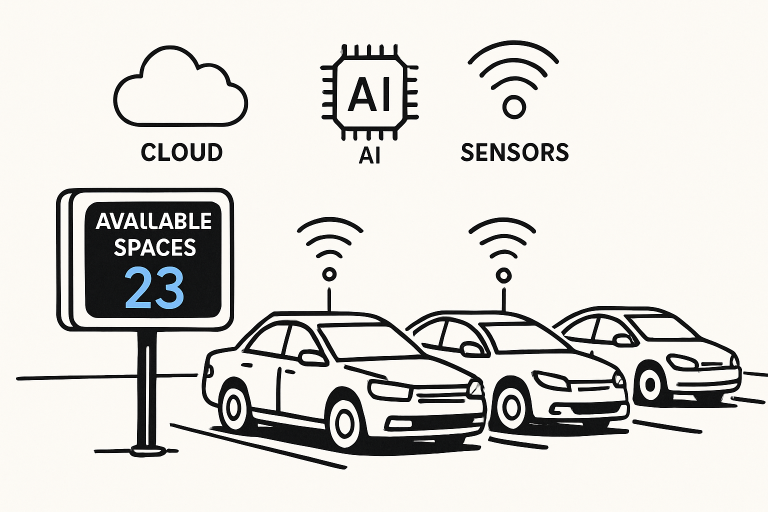
The Internet of Things (IoT) is at the forefront of transforming parking environments by providing granular, real-time data about parking space utilization. Smart sensors embedded in the pavement or mounted on overhead fixtures monitor space availability and automatically relay information to digital signage, guiding drivers efficiently to available parking spots. This not only minimizes search time and traffic congestion but also cuts emissions by reducing unnecessary driving.
IoT-connected infrastructure supports more effective maintenance planning, occupancy reporting, and responsive management. By connecting parking assets to a unified digital platform, operators can enhance utilization, streamline payments, and provide a more customer-friendly parking experience. As a result, IoT is now a cornerstone feature of next-generation parking ecosystems.
Cloud-Based Platforms
Cloud technology is revolutionizing the operational side of parking management, offering both scalability and unmatched flexibility. With data storage and interfaces accessible from anywhere, facility managers can remotely monitor performance, adjust access controls, and integrate with other property management software securely. Cloud solutions accelerate the deployment of upgrades and functional enhancements, removing the need for costly, on-site hardware maintenance.
Beyond core operations, cloud-based platforms are driving new layers of convenience for both end-users and administrators. Whether it’s integrating guest communication tools, HOA compliance frameworks, or additional payment systems, cloud architecture affords seamless expansion without interrupting daily workflows. The result is greater resilience, ongoing innovation, and a superior overall experience for all stakeholders.
Automated Enforcement and Security
Compliance and security are crucial elements in parking management, and recent advancements in automation are enhancing the reliability and efficiency of these processes. Automated license plate recognition (ALPR) systems, supported by machine learning and high-resolution cameras, have revolutionized enforcement by enabling swift identification of violations and verification of permitted users.
These technologies significantly reduce human error, expedite citation issuance, and enable staff to concentrate on more complex security concerns. Integrated security controls, such as real-time monitoring and remote lockdown capabilities, further reduce risk and improve operational outcomes. For environments requiring strict access management, these systems deliver peace of mind and the integrity of regulated operations.
Sustainable and Green Solutions
Sustainability is gaining traction as a defining goal for modern urban infrastructure, and parking management is no exception. New software applications support eco-friendly policies by optimizing electricity consumption (e.g., dynamic lighting, real-time occupancy monitoring) and facilitating seamless EV charging station integration. As cities advance toward their green mobility targets, parking technologies will play an increasingly important role in reducing environmental footprints and supporting alternative forms of transportation.
The adoption of intelligent sensors and dynamic energy controls in parking structures has proven effective in lowering utility costs and minimizing overall emissions. Operators can designate spaces for electric and low-emission vehicles to encourage sustainability-minded behavior, making parking management a vital player in broader climate initiatives.
Conclusion
The drive to modernize urban mobility is positioning parking management software at the intersection of technology, sustainability, and user experience. With accelerating momentum behind AI, IoT, cloud integration, automated enforcement, and sustainability measures, industry leaders are demonstrating what’s possible with data-driven innovation. Entities that leverage these key trends will benefit from greater efficiency, environmental stewardship, and more robust urban infrastructure for years to come.
