Lost Wax Casting Technologies: Attaining Complex Forms with Precision
The manufacturing industry thrives with the necessary intricacies and precisions of its designs. Lost wax casting (sometimes called investment casting) has provided a superior means of fabricating highly accurate metal pieces for various industries (e.g., aerospace, automotive, marine, energy) as other manufacturing alternatives are declining. Given the intricacies of designs, geopolitical industries are calling for components with tighter tolerances, smoother machining, and intricate geometries. Consequently, wax casting has become a lucrative industry for casting metal pieces across various sectors of the economy.
B2B firms can now have partnerships with precision casting service providers and can access some of the lost wax casting practitioners technologies. Altering the lost wax casting process for either prototyping or mass production continues to maintain the delicate balance, precision, and cost efficiency of the technology.
This piece analyzes lost wax casting, the technology’s modern adaptations (e.g., vacuum investment casting, digital modeling), and the technology’s remaining position as a leader in the production of advanced components.
The Lost Wax Casting Process
While lost wax casting is one of the oldest metal-forming methods, it is still crucial in today’s precision engineering for its capability of reproducing complex designs with near-net shape accuracy. There are several defined stages in the process which are as follows:
- Wax Pattern Creation: This pattern is made from an injection mold, which serves to create an exact replica of the geometry of the final component.
- Assembly and Shell Building: Many of the wax patterns are joined together by a single wax sprue, forming a tree. The complete assembly is taken through a process involving a ceramic slurry and fine sand to construct a strong shell.
- Wax Removal: This process consists of the melting of a wax material, which results in the forming of a hollow ceramic mold.
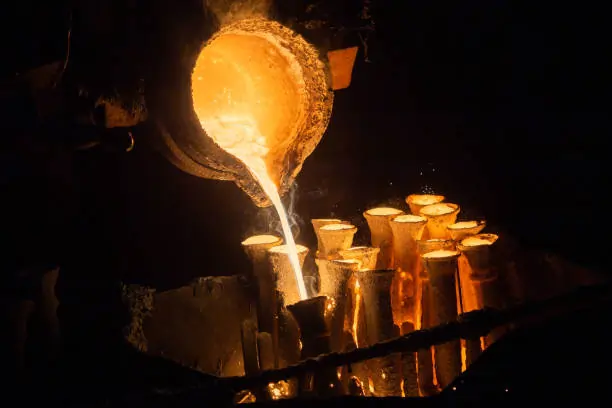
- Metal Pouring: A controlled, and potentially vacuum, environment is often used to pour the molten metal into the shell to oxidize and keep impurities from entering the mold.
- Shell Removal and Finishing: After the metal has cooled and solidified, the ceramic shell is removed. From there, the part is cleaned, heat treated, and machined.
The versatility of the process allows the casting of complex internal cavities, thin walls, and detailed features that may be challenging to achieve by machining or forging. Because of this, lost wax casting is the best choice in the manufacture of turbine blades, valve bodies, and pump impellers.
Precision casting manufacturers rely on control of advanced process systems and computer-aided control to optimize metal flow and filling and cooled molds to avoid error and control accuracy in measurement.
Lost Wax Casting with High Precision and Complex Forms
The lost wax casting process can create complex shapes with great detail, and this is one of the many advantages of this casting method. Investment casting, unlike other casting processes, does not leave a company with a piece that requires machining or complex assembly to achieve the desired final product.
Some key advantages of this process are:
- High Dimensional Accuracy – Tolerances for this machining process are easily achieved in the CT4 to CT6 range and are perfect for engineering processes that require accuracy.
- Superior Surface Finish – With only a roughness of Ra 3.2, the parts created by this process require little to no polishing.
- Flexibility in Design – This process can replicate complex internal features, undercuts, and fine textures.
- Flexibility in Material – This process works for many different metals and alloys including stainless steels, carbon steels, and certain nickel and cobalt alloys.
Precision and dimensional accuracy are crucial to many industries, building parts with severe criteria. Lost wax casting, with its attributes, serves as an Aerospace engineer’s casting method to develop turbine parts and automotive manufacturers’ casting method to develop lightweight, high-end parts.
Most recently, the combination of digital technologies and vacuum investment casting have improved these attributes. Castings made with vacuum technology are free of oxidation and contamination, producing a casting with greater uniformity and strength. When utilized with sophisticated 3-D modeling and simulation software, technology casts with the most intricate patterns without deviation.
Performance Optimization and Material Science
Material selection is a key attribute of lost wax sculpting, and each alloy has its distinct performance attributes. A dependable** precision casting manufacturing** ranges numerous elements, and each are differentiated based on mechanical property, corrosion resistance, and thermal performance.
Materials most frequently used are as follows:
- Stainless steels: Marine, food and medical sectors require strength and corrosion resistance.
- Carbon and low-alloy steels: A field of industries require durable and wear resistant components.
- Nickel-based alloys: Aerospace and turbine systems require high-temperature operational environments.
- Cobalt-Based Alloys: For excellent wear as well as heat resistance in components like valves, pumps, and energy systems.
Heat treatment and finishing processes enhance the strength, hardness, and durability of these materials. Parts may be subjected to solution annealing, quenching, and/or tempering to strengthen the mechanical performance in tune with the application.
The Combination of CNC Machining and Quality Assurance
Impressive precision is delivered by lost-wax casting alone, but final dimensions and perfect assembly compatibility are achieved by post-casting machining. Modern foundries opt to interface with CNC machining systems for micron-level tolerances, and as a result, offer customers fully finished components that are ready to be used right away.
The amalgamation of casting and machining in a single facility prevents the need for numerous outsourcing steps, enhancing supply chain efficiency. For B2B customers, this translates to shorter lead times, a reduction of in-field quality gaps, and decreased overall production expenses.
The same importance is attached to quality control. Each component is ensured to comply with the international standards with advanced methods of inspection and testing, which cover:
- Non-destructive testing (NDT): Internal defect detection using x-ray, ultrasonic, and magnetic particle inspection.
- Coordinate Measuring Machine (CMM): Checks how dimensions are done accurately.
- Metallurgical analysis: Looks at alloy structure properly and if there’s any grain ratio composure.
Applicable customer satisfaction and auditing industrial specifications are done and implemented. These are important and used all over the world by B2B customers.
Advantages for B2B Supply Chains
The benefits of losing wax casting for industrial buyers and OEMs goes beyond the quality of the product. An experienced precision casting manufacturer helps smoothen production processes and improves the performance of the entire supply chain.
The main benefits are:
- One-stop production: Everything from casting, machining, heat treatment, and finishing done in line of production.
- Reduced lead times: Use of automated and planned system processes for a faster delivery.
- Cost efficiency: Making to a near-net shape means lower machining and material costs due to the lower waste.
- Supply reliability: Predictable and consistent outcome means the same is done repeatedly to produce the product in bulk.
- Design collaboration: Partnership between the manufacturer and client helps improve the design of the component for optimal performance.
Also, the use of vacuum investment casting made it possible for businesses to manufacture in a way that meets both global quality standards and quality standards. Modern foundries improve the operational sustainability of their B2B partners by minimizing emissions and recycling materials. These practices help modern foundries improve their energy efficiency.
Conclusion
Lost wax casting is one of the oldest manufacturing techniques chain casting. It is still one of the best options for creating intricately detailed and high-precision metal parts. The art continues to be refined by the integration of new technologies like CNC and Vacuum investment casting and is now providing high-quality solutions for numerous industries.
Working with the best precision casting manufacturers gives you the best engineering capabilities and material science applications, backed with superior technology and robust multidisciplinary access for an optimized process. From design adjustments to the timely shipment of the end parts, investment casting continues to give industries the much-needed balance of reliability and speed to be competitive in the market.
In a world market where technologies are driven by a balance of performance and precision, lost wax casting technologies set the pace. It continues to stand out by providing the ability to rapidly and accurately deliver high-quality end parts from complex designs. This technology has reshaped the world of manufacturing and will continue to innovate.
Read more: Why Do Metal Roofs Rust in West Bradenton but Not in Lakewood Ranch? – SizeCrafter
Titan Elite E-20 Sprayers Parts for Long-Lasting Results – SizeCrafter
Top Quality Shampoo Brands Available in Singapore for Healthy, Beautiful Hair – SizeCrafter
